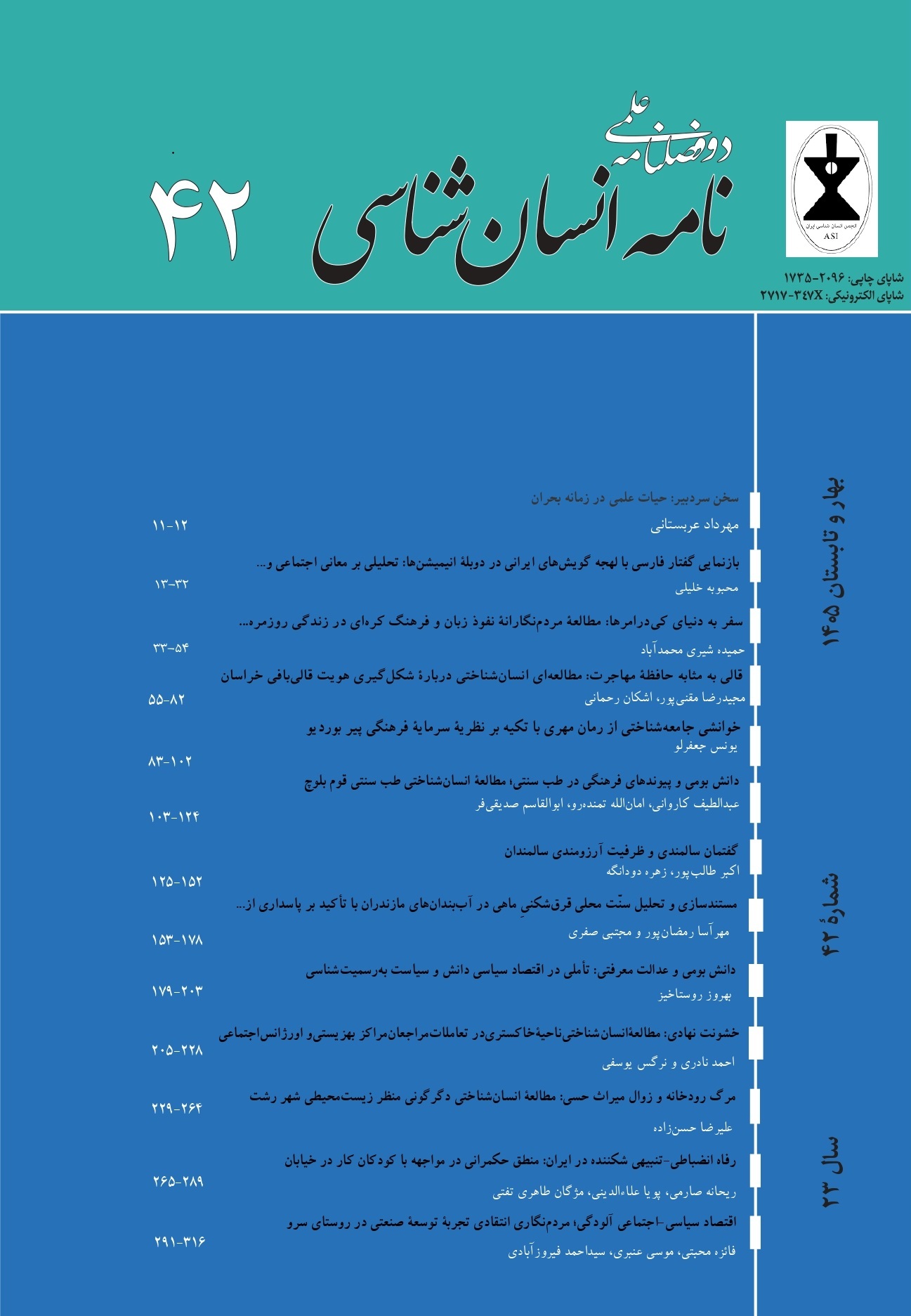
سخن سردبیر
عنوان مقاله English
Today, in the summer of 2026, our country remains in a state of suspension caused by extensive regional and international tensions—tensions that erupted into a full-scale war, persisted through political maneuvers and sporadic attacks, and whose future remains obscure. In such a predicament, the fundamental question for research and education concerns the very value, meaning, and necessity of academic life.
When the future is clouded and society sinks into a heavy silence, despair, torpor, and isolation threaten the foundational principles of the social fabric. The continuity of a dynamic society always requires a narrative—a story that stitches together societal ruptures and voids, uniting individuals within the promise of a future totality. In the absence of such a hopeful fantasy—when the life of the Iranian subject is framed primarily around lack and trauma—what is reproduced is a cycle of nostalgia, regret, and a vague dread of tomorrow; a dread that reduces the horizon of progress to a bare strategy for survival, sowing seeds of frustration and anger.
Against this backdrop, the students who seriously seek knowledge and skill, and the researchers who pursue their research and its publication, are the bright points where the Iranian subject resists despair, makes sense of his/her life, and keeps hope alive. These glimmers of hope are by no means limited to academia; groups gathered around art, sports, and various civic initiatives serve as other vital quilting points that reinforce the pillars of social life. Perhaps these intellectual efforts are the academic community's contribution to generating meaning and restoring society's cohesion.
Beyond this contingent crisis, the global academic community is grappling with an existential challenge: the rapid rise of Artificial Intelligence and its still-ambiguous implications for education and research. The coming years will undoubtedly test academic institutions to their core. The very nature of education is transforming: conventional lecturing and the mere transmission of information are rapidly losing their efficacy, and the skills that once demanded repetitive practice and training are being radically redefined. Now, academic institutions are trying, through trial and error and by incorporating new technologies, to reorganize academic structures and redefine the role of human agency and innovation in it.
While the most immediate concern often seems to be plagiarism and machine-generated submissions, the ramifications run far deeper. Academic institutions and journals have begun issuing guidelines on the ethical use of AI; yet, beyond formal technical parameters, these protocols still rely heavily on self-disclosure and the scholar's intellectual integrity. What fundamentally validates academic work is the originality of the research question, the rigor of the data, and the coherence of the analytical argument—qualities that truly earn a work its author's signature. Although technical measures, such as embedded watermarks in the outputs of certain AI platforms (like Claude), are being developed, it remains difficult to cleanly distinguish fully synthetic texts from original scholarship enriched through thoughtful human-machine interaction. At the same time, unprecedented access to the repository of human knowledge has raised the bar, which raises expectations that research results will add something to existing knowledge
Ultimately, the intersection of these two concerns reveals a shared truth: whether in historical turbulences and social suspension, or in the face of waves of new technologies, academic life remains legitimate by maintaining thoughtful agency and resisting the loss of meaning. The articles in volume 42 of the Iranian Journal of Anthropology are modest yet resolute steps in this direction, reflecting a commitment to research at a time when critical thinking itself has become an act of hope.
Mehrdad Arabestani
Editor-in-chief of the Iranian Journal of Anthropology
September 2026